
What is pre-compliance testing?
Pre-compliance testing means measuring the EMC status of a product during development – not only on the finished device. Such measurements are possible in accredited and in non-accredited laboratories; they differ in purpose, not in diligence.
What exactly is pre-compliance?
Pre-compliance tests are measurements taken during development that capture the EMC status of a product while it is still being built. The aim is to spot problems while there is still room to act – that is, before boards are ordered, enclosures machined or volumes produced.
Anyone who discovers problems only at the end often has few options left: boards already ordered cannot be changed, and corrections during series production quickly become very expensive.
Pre-compliance measurements and accredited tests have different jobs. At the pre-compliance stage, the point is to find causes, compare variants and verify measures. An accredited test serves as formal evidence following defined procedures.
Which evidence your product requires depends on the product, the applicable standard, the target market and your customers’ requirements. That should be clarified case by case – we support the technical assessment.
Development-stage measurement and formal testing
Two different purposes, not a substitute for one another. One accompanies development, the other produces evidence.
Development-stage measurement
- Analysis and optimisation during development
- Variants and changes can be investigated
- Causes can be narrowed down
- The result is measurement data, a technical assessment and recommendations
- not accredited at EMC Labs
Formal testing
- Evidence produced under a defined test order
- Procedure and documentation follow the applicable requirements
- Changes may require further test runs
- The result follows from the formal evidence required
- accreditation may be required depending on product, market, standard or customer requirement
Which formal evidence is required depends on the product, the target market, the applicable standards and customer requirements. We support the technical assessment, but we do not provide legal advice.
Advantages of pre-compliance testing
Changes early and cheaply
Finding problems early is considerably cheaper than reworking after the conformity test – layout, cabling and enclosure can still be changed before the design freeze.
Time gained during development
Taking EMC into account early avoids months of delay in approval. Problems that only surface at the end can push the market launch back by months. Faster scheduling in our lab helps on top of that.
Fewer surprises
Critical frequency ranges and operating states are known and assessed before the later conformity test – instead of turning up in the final test.
Support during development
We do not only test: we give concrete pointers for optimisation – from a layout review to a filter recommendation.
How a pre-compliance test runs
From the enquiry to the test report – transparent and efficient
Preparation and consulting
1–2 weeks beforeJoint analysis of the device under test. We clarify requirements, the applicable standards and the equipment needed, and prepare the test setup. The earlier this step starts, the better.
Setup and configuration
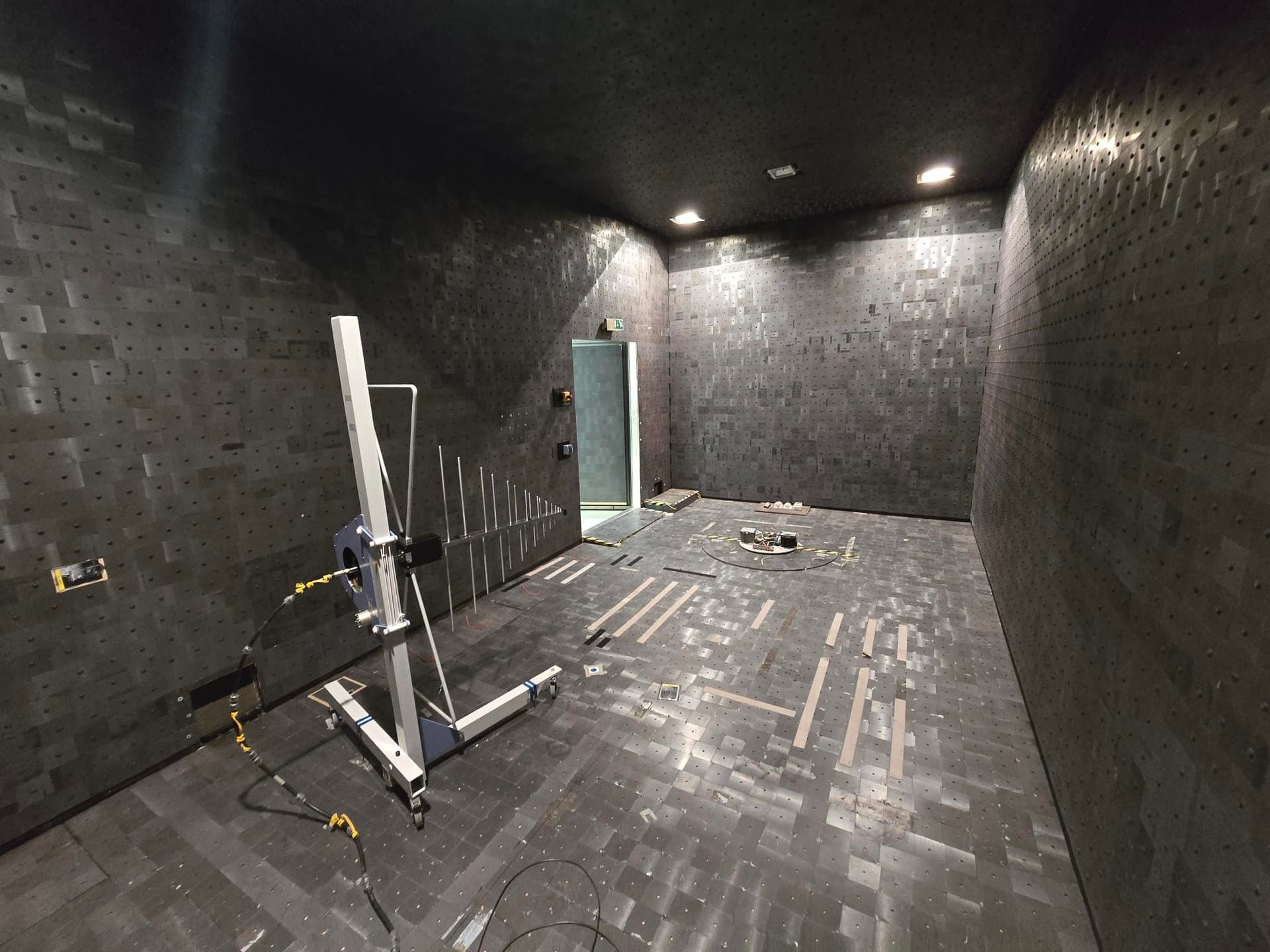
up to 3–4 hoursThe device is set up in our anechoic chamber and the test setup is configured. Depending on the complexity of the device and the measurement environment, this can take longer.
Radiated emissions measurement
1–2 daysMeasurement of radiated emissions. Depending on the test scope, the device is rotated, the antenna height varied and the setup adapted for further operating states.
Immunity testing
3–5 daysESD, burst, surge as well as radiated and conducted immunity. The scope depends on the applicable standards.
Test report
as agreedOnce the measurements are complete, you receive a report with the results and the comparison against limits. Further consulting and optimisation recommendations can be booked separately.
Which measurement fits when
Typical during development:
- New developments before production readiness
- Prototype validation
- After design changes
- Supplier assessment of components
- Troubleshooting EMC problems
Clarify formal evidence in advance:
- Completing the technical documentation for CE marking
- A customer asks for an accredited test report
- Regulated fields such as medical devices, where the route to evidence may be prescribed
- Homologation in the automotive sector
- Market access outside the EU, for example with an FCC context

Request a pre-compliance measurement
Briefly describe your device and its development stage. We will propose a suitable test scope.