
Immunity testing
We test how your device reacts to disturbances – and use the results directly for troubleshooting and for verifying measures. Which of our two test environments fits follows from the test method and the device under test.
- Service
- Immunity testing and observing how the device reacts
- Location
- Harbke and Meine
- Test types
- radiated, conducted, ESD, surge, burst
- Result
- Documented behaviour of the device per disturbance
Two test environments. One shared EMC capability portfolio.
Our two test environments together form the EMC capability portfolio of EMC Labs. The appropriate environment and test setup depend on the test method, device under test, supply requirements, setup and engineering question.
Emissions
- radiated emissions
- conducted emissions
Immunity
- radiated immunity
- conducted immunity
- ESD
- surge and burst
Diagnostics and optimisation
- near-field investigations
- root cause analysis
- verification of optimisation measures
These capabilities are provided across our two test facilities. The appropriate facility and test setup are selected for each project.
Request the right test environmentCapabilities and technical data
Confirmed supply figures for the shielded chamber at the Meine site (Lower Saxony, Germany). The test types themselves are covered by both test environments together.
- AC supply
- single-phase, up to 16 A
- DC supply
- up to 60 V, 10 A
Which tests make sense in a specific case, and which levels we work with, we agree per project in advance.
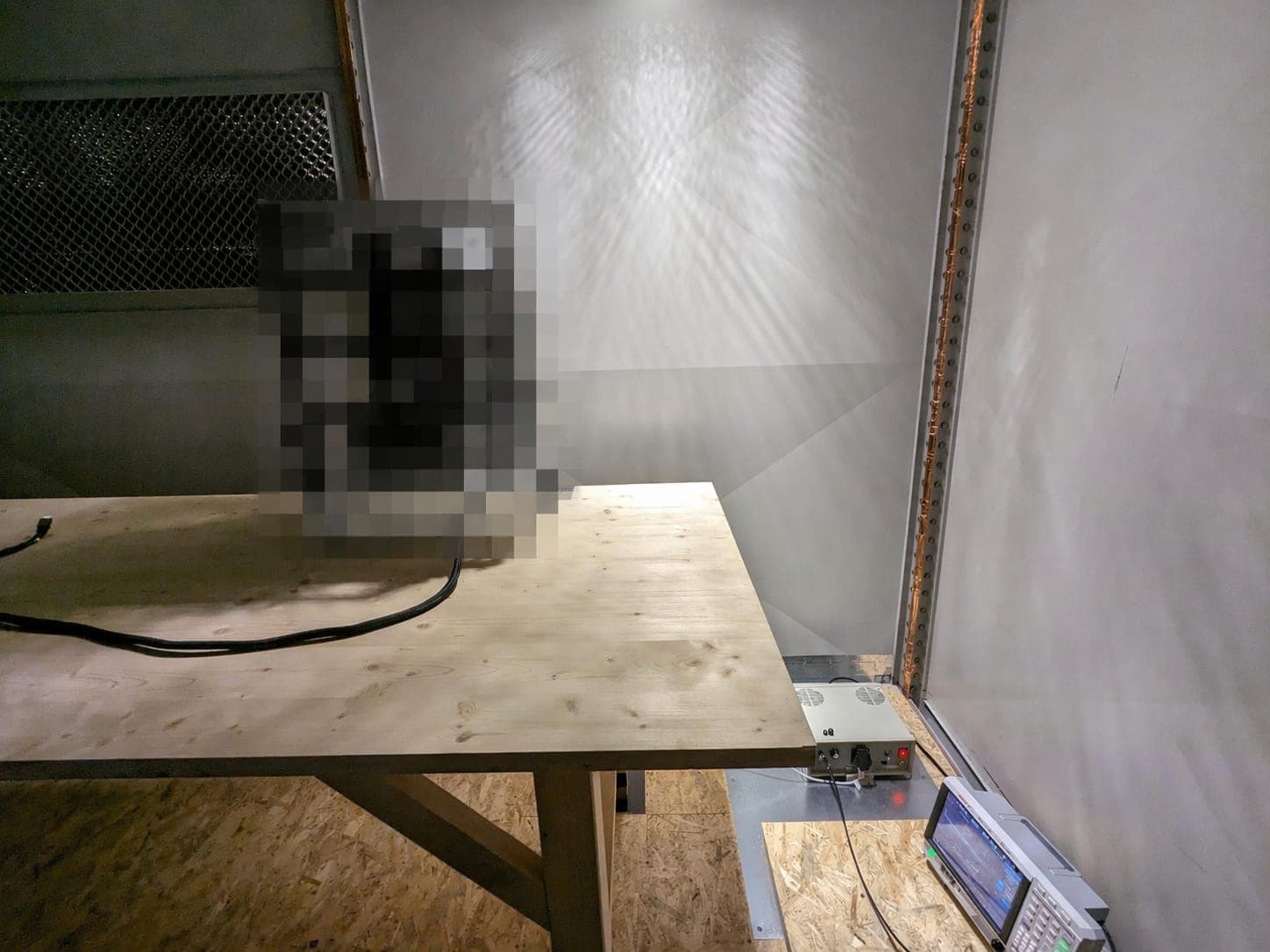
During the test
What happens during the test
For us, immunity testing is not a run-through against a fixed list. We observe the device, record its behaviour and try changes out directly on the setup. What lies behind the individual disturbances, and how they differ in pulse shape, duration and repetition, is described in ESD, burst and surge compared.
Which disturbances, which levels and which coupling points make sense is defined together in advance – depending on the product, its environment and the question. After that, the test runs in four steps.
Observe how the device reacts
Does a function drop out, are there resets, communication errors, display faults or permanent damage? We record which assembly reacts and at what level.
Document malfunctions
Every anomaly is logged with the disturbance, the level, the coupling point, the operating state and the observed behaviour – so it stays traceable and repeatable.
Try changes out immediately
Filters, shield bonding, grounding or cable routing can be changed on the setup. Workshop and development bench are on site.
Re-measure measures individually
Every change is tested on its own. That way it is documented in the end which measure worked – not just that the combination helps somehow.
Where we put the emphasis
These tests serve development: we want to understand why a device reacts – not just establish that it does.
Diagnosis
We observe how your device behaves under disturbance: which function drops out, which assembly reacts, and at what level the effect appears.
Development support
Right at the chamber, changes to the setup can be tried out – filters, shield bonding, cable routing – and assessed one at a time.
Verification
After a measure has been implemented, we test again under identical conditions so that the effect is documented.
Typical use cases
- Locating interference sources on the board or a cable instead of swapping parts on suspicion
- Observing and documenting how the device behaves under transient disturbances
- Measuring the effect of filter, shielding and grounding changes straight away
- Preparing the setup and operating states for a later external test
Limits of the equipment
- The supply is limited to DC 0–60 V / 10 A and single-phase AC 16 A.
- We do not state blanket figures for the internal dimensions, device size or frequency range – these are clarified per project.
- We measure at the pre-compliance stage. These are not accredited tests.
Related pages

Have your immunity tested
Briefly describe the anomaly you are seeing, or which tests you are preparing for. We will come back to you with an assessment and a proposed date.