
Supporting EMC across the whole development path
Development support means that EMC is part of the decisions from the concept phase onwards, and not a test topic only at the end. Measurements, consulting and root cause analysis interlock along the way.
- Service
- Supporting EMC through concept, design, prototype and optimisation
- Location
- Harbke and Meine, Germany
- Collaboration
- project-accompanying, recurring
- Result
- EMC status per project phase, documented continuously
Why timing decides
In the concept phase, EMC-relevant decisions are still cheap: where the interfaces sit, how the grounding is built, which cables leave the enclosure, where there is room for filters.
On the finished device, the same questions are expensive. Boards are manufactured, tooling is ordered, dates are promised. What remains are add-on measures that need space, money and time.
Development support moves EMC decisions to the point where they still have room to manoeuvre.
The path from idea to production readiness
Four phases, each with its own guiding question. Not every project starts in phase one – you can join at any point.
Concept
Which EMC requirements are coming for this product?
- Talk through the environment, the target market and the type of product
- Narrow down the relevant standard families and name the open points
- Identify EMC-critical functions in the concept
An assessment of which requirements will apply later and which concept decisions have EMC consequences.
Design
How can EMC be taken into account in the design?
- Go through schematic, layout, cabling and mechanical setup together
- Assess grounding, filter positions, shield bonding and openings in the enclosure
- Define the measurement strategy for the later prototype
Annotated notes on the design and a measurement plan that matches the development stage.
Prototype
Where does the product really stand in measurement terms?
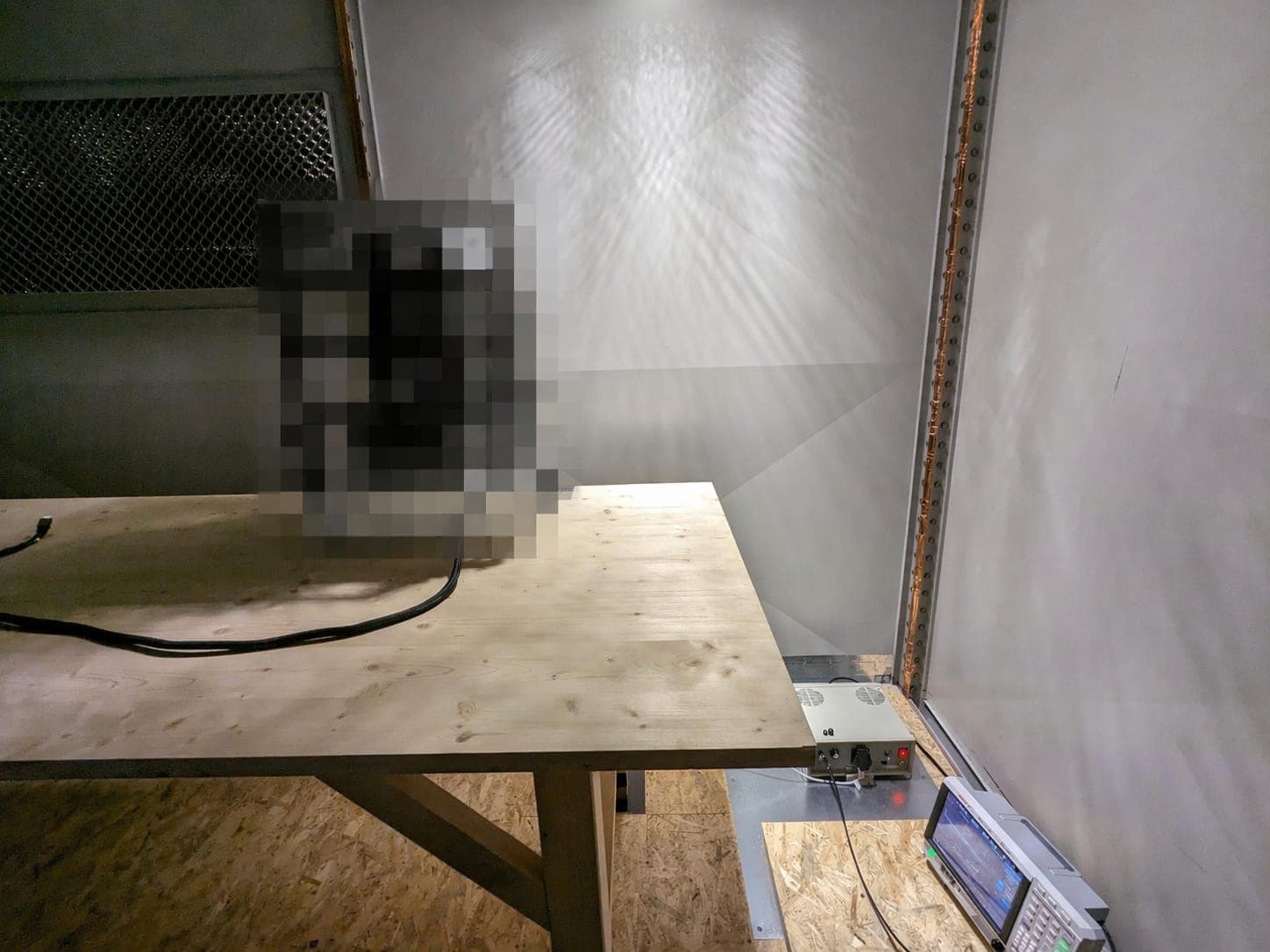
- Measure emissions – radiated and conducted
- Test immunity and narrow it down with near-field investigations
- Document the setup, the operating states and the boundary conditions
Measurement data with a comparison against limits, a technical assessment and traceable documentation of the setup.
Optimisation
What does each measure actually achieve?
- Locate the cause of an anomaly instead of swapping parts on suspicion
- Derive measures for layout, cabling, filtering, shielding or enclosure
- Check the effect in a re-measurement under identical conditions
Prioritised measures and a documented before-and-after comparison for your development decision.
What the support is made of
You can commission the building blocks individually or combine them across the whole development path.
Pre-compliance measurements
The measurements themselves – radiated emissions, immunity and near field – with a technical assessment.
See detailsEMC consulting
Clarifying requirements, measurement strategy and reviews of layout and setup before and between the measurements.
See detailsRoot cause analysis and optimisation
Locating interference sources, deriving measures and verifying them by re-measurement.
See detailsAnonymised example from practice
A control unit is to be integrated into an industrial plant. A pre-test shows an exceeded limit in the lower frequency range; the cause is unclear.
Near-field investigation on the assembly and the cables, then targeted variation of cable routing and shield bonding – each change measured on its own.
The cause could be attributed to one assembly. The team implemented two measures, and the effect was documented in a re-measurement under identical conditions.
What we commit to – and what we do not
We commit to measuring, to placing results in technical context, to narrowing down causes with measured evidence and to re-measuring measures. We do not commit to a product passing an external test or receiving CE marking: that depends on the implementation, the final setup, the applicable standards and the manufacturer’s conformity assessment.

Discuss development support
Briefly describe which phase your project is in. We will suggest which building blocks make sense now.